Sep 20, 2026 / By Lux Carbon / in Carbon Fiber Guides
Carbon fiber is one of the few materials that can look completely natural on a Lamborghini—provided the part fits the exact model, the weave and gloss work with the rest of the car, and the installation does not make the upgrade look added on. Owner discussions around Huracan, Urus and Aventador modifications repeatedly return to the same questions: is the component genuinely carbon, will the panel gaps be clean, will the finish match OEM carbon, and is a complete aero package better than installing isolated pieces?
This guide is the starting point for the Lux-Carbon Lamborghini content cluster. It covers the main upgrade paths, the difference between visual and structural parts, dry carbon versus conventional composite construction, fitment checks and the products worth comparing before ordering. Start with the full Lamborghini carbon fiber parts catalog and use the model-specific sections below to narrow the choice.
For a street-driven Lamborghini, the most coherent first upgrades are usually the parts that visually frame the factory body: front lip or splitters, side skirts, rear diffuser or rear splitters, mirror covers and a restrained spoiler. Those pieces create a continuous carbon line around the car without requiring a full widebody conversion.
| Upgrade | Main effect | What to verify |
|---|---|---|
| Front lip / splitters | Sharper lower front profile | Model year, bumper version, ground clearance |
| Side skirts | Connects front and rear aero visually | Door clearance, mounting points, left/right symmetry |
| Rear diffuser / splitters | Finishes the lower aero package | Exhaust layout, bumper variant, mounting hardware |
| Spoiler / wing | Strongest visual change | Deck shape, drilling/tape method, alignment |
| Mirror covers / vents | Subtle OEM+ carbon detail | Add-on vs replacement design, weave direction |
The Huracan is especially sensitive to proportion. A very aggressive wing combined with an otherwise stock lower body can look disconnected, while a front lip, side skirt and diffuser package tends to read as one design. The Huracan LP600/LP610 dry-carbon front bumper lip is a logical front-end starting point, while the Huracan LP610 dry-carbon rear diffuser gives the rear the same material language.
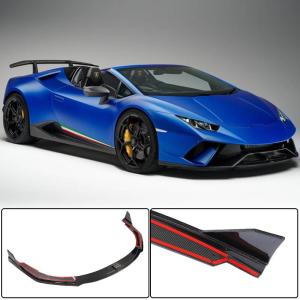
If the goal is a more complete setup, add Huracan carbon fiber side skirt extensions and then decide whether the car needs a spoiler. The standard carbon option is the Huracan LP610/LP580 rear trunk spoiler; a dry-carbon alternative is also available in the catalog. For a more detailed fitment breakdown, see the Huracan carbon fiber front lip guide, the Huracan diffuser and side-skirt review and the Huracan spoiler and wing review.
The Performante already has a strong factory carbon identity. That makes mismatched texture, weave or gloss more obvious than on a base car. A carefully selected Performante carbon fiber front lip can extend the factory lower line, but the correct approach is to compare the new part against the existing forged-carbon and clear-coated surfaces in daylight before committing to multiple additions.
The biggest owner debate is not whether carbon belongs on the Performante; it is whether aftermarket carbon should imitate the factory appearance exactly or intentionally use a contrasting woven pattern. There is no universal aesthetic answer, but there is a practical rule: repeat the same material treatment in at least two visually connected locations. The detailed reasoning is covered in the Huracan Performante carbon upgrade guide and the forged carbon vs woven carbon guide.
Because the Urus has larger body surfaces, smaller carbon parts can disappear visually unless they form a coherent package. The Urus 2018–2022 dry-carbon front bumper splitters, matching dry-carbon rear bumper splitters and dry-carbon wheel eyebrow arch trims can create a continuous theme without replacing major body panels.
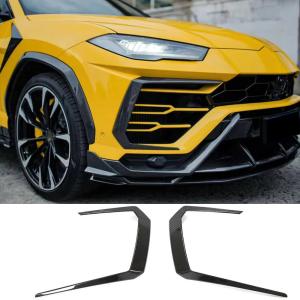
For an OEM+ look, combine those lower pieces with Urus/Audi Q8 dry-carbon mirror covers or Urus dry-carbon side air fender vents. Under the hood, the Urus dry-carbon engine-bay covers add visible carbon when the bonnet is open without changing the exterior silhouette. See the complete Urus carbon fiber parts guide and Urus dry-carbon mirror cover review for model-specific checks.
The Aventador is already angular and dramatic, so each added carbon panel has a larger visual impact. The safest strategy is to start with connected components: LP700-4 carbon fiber front bumper lip, LP700-4 carbon fiber side skirts and LP700-4 carbon fiber rear bumper. This gives a front-to-rear theme instead of an isolated carbon accent.
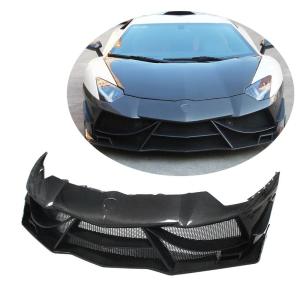
Owners also consider the Aventador carbon fiber engine bonnet hood cover and door-side air fender vent when they want carbon above the beltline. Before installing the front lip, measure real-world approach angles at the driveway, parking ramp and transport trailer you use. The Aventador LP700 carbon body-kit review and Aventador hood and vent review cover those decisions in detail.
“Carbon fiber” describes a family of constructions, not one identical product. Dry/prepreg parts are typically chosen for low resin content, crisp surfaces and weight efficiency. Conventional resin-infused or wet-lay carbon can still be an excellent exterior cosmetic component when the mold, laminate and clear coat are good. Forged or chopped-carbon composites create a random marbled appearance rather than the directional twill weave familiar from traditional carbon cloth.
For exterior styling, consistency matters as much as theoretical material performance. A perfectly made twill-carbon mirror cover can still look wrong beside a factory forged-carbon panel if the textures clash. Conversely, mixing materials intentionally can work if the same contrast repeats elsewhere on the car. Inspect weave alignment, edge finishing, clear-coat depth, mounting surfaces and backside construction instead of relying on marketing terminology alone.
Small add-on covers may use automotive acrylic tape, while front splitters, diffusers, skirts and larger spoilers can require screws, factory mounting points, brackets or a combination of mechanical and adhesive fixation. High-speed aero components should never be installed on the assumption that tape alone is sufficient unless the specific part and manufacturer explicitly call for it.
Before installation, clean and degrease contact surfaces, test the part at normal ride height, check wheel and door movement, and inspect the underside for contact points. After installation, re-check fasteners and alignment after the first drives. On very low Lamborghinis, the most expensive problem is often not the carbon itself but avoidable contact with ramps or curbs.
No. The market includes full carbon, carbon-skinned composite, fiberglass with a carbon layer and purely decorative hydro-dipped parts. Product construction should be verified individually.
Dry/prepreg carbon is attractive for low weight and precise laminate control, but for a cosmetic exterior part, fitment, surface quality, UV-stable clear coat and mounting design are equally important.
For an OEM+ build, matching weave direction, gloss level and scale usually produces the most coherent result. Intentional contrast can work, but it should look deliberate rather than accidental.
For most street cars, begin with the front lip or splitters and then build a continuous lower-aero package with side skirts and rear diffuser/splitters.
Use the Lux-Carbon Lamborghini catalog and then filter the upgrade by component category such as front lips and splitters, rear diffusers, side skirts or mirror covers.
A good Lamborghini carbon build is not measured by how many panels are replaced. It is measured by fitment, consistency and whether the additions respect the original geometry. Confirm the exact vehicle variant, choose a repeatable finish, dry-fit every part, protect ground clearance and build the package in stages. That approach answers most of the quality and authenticity concerns that appear in real owner discussions—and it produces a car that still looks intentional years later.
Oct 03, 2026 by Lux Carbon
Oct 03, 2026 by Lux Carbon
Cookie preferences