Sep 20, 2026 / By Lux Carbon / in Carbon Fiber Guides
On a Lamborghini Huracan, the rear diffuser and side skirts do more than add exposed carbon. They define the lower silhouette of the car. When the two are selected together, they create a continuous line from the front wheel opening to the rear bumper and make a carbon front lip look like part of a complete package rather than a standalone accessory.
This review focuses on the Huracan LP610 2014–2018 dry-carbon rear bumper diffuser and Huracan 2014–2018 carbon fiber side skirt extensions, with practical guidance on fitment, weave consistency, installation and how to combine them with the rest of the Lamborghini carbon catalog.
Owner-modification discussions often focus on individual parts, but the visual result is determined by the relationship between them. A diffuser adds visual mass low at the rear. Side skirts extend that mass along the rocker area. If one is aggressively shaped and the other remains stock, the car can look rear-heavy or unfinished.
Planning both components at the same time also helps with material consistency. Gloss level, weave direction and carbon scale can vary between suppliers or production batches. Matching adjacent lower-aero components is easier when the finish is chosen as one package.
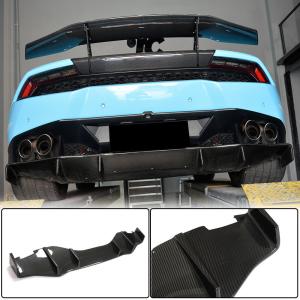
The LP610 dry-carbon rear bumper diffuser is designed for the 2014–2018 generation listed on the product page. A rear diffuser sits close to heat, road spray, debris and exhaust outlets, so surface finish is only one part of the quality check.
A diffuser should look centered when viewed from several meters behind the car. If one corner appears higher, forcing it with fasteners can place stress into the laminate and worsen the gap over time.
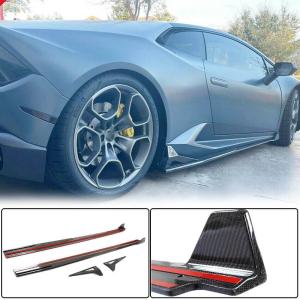
The Huracan carbon fiber side skirt extensions extend the carbon line between the front and rear wheels. They visually lower the side profile without changing the roofline or upper body. On a low car, however, side skirts live in a high-risk zone for lift arms, steep ramps and road debris.
Before installation, check door opening clearance and where workshop lifting equipment contacts the chassis. The side skirt should not obstruct safe lifting points. Ask the installer to document the lifting procedure after the new components are fitted so future service work does not damage them.
Dry carbon is appealing for its low resin content and lightweight construction. But on a lower-aero component, impact resistance, edge finishing and mounting design are just as important. A heavy part with poor mounting can be a problem; an extremely light part with fragile unsupported edges can also be a problem.
| Quality check | Why it matters on diffuser/skirts |
|---|---|
| Edge sealing | Protects exposed laminate from moisture and chips |
| Mounting flange thickness | Reduces local stress around screws and clips |
| Clear-coat uniformity | Improves UV resistance and visual consistency |
| Weave direction | Important where left/right parts mirror each other |
| Heat clearance | Critical near rear exhaust components |
If the car already has a dry-carbon Huracan front lip or carbon front splitters, the diffuser and skirts create a logical three-part lower-aero package. That is usually more cohesive than adding a large spoiler first.
The Huracan front lip guide explains the front options, while the Huracan spoiler and wing review covers the point at which a rear spoiler adds balance rather than clutter. For a broader model comparison, return to the Lamborghini carbon fiber parts pillar guide.
A diffuser visually widens and lowers the rear. A spoiler adds height and draws attention upward. On a Huracan with a stock deck, the LP610/LP580 carbon trunk spoiler can add a restrained upper carbon element. The dry-carbon spoiler alternative is another route for owners prioritizing material consistency with a dry-carbon lower package.
The key is scale. If the diffuser is subtle, a subtle spoiler usually works. If the rear lower package is very aggressive, a larger aero element can look more proportional—but it should still suit the car's use and mounting requirements.
Clear-coated carbon should be washed with the same care as painted bodywork. Avoid aggressive compound on sharp edges, where clear coat can be thinner. Remove insects and road contamination from the diffuser and skirt leading edges promptly. If the car is ceramic coated, confirm that the coating is compatible with the carbon clear coat and that any matte sections are treated with a matte-safe product.
Inspect underside mounting points periodically. A carbon part can look undamaged from above while a fastener or bracket underneath has loosened after contact with road debris.
Yes, but the rear will have more carbon visual weight than the side profile. Many owners prefer to connect the package with carbon skirts.
Do not assume compatibility. Check the exact product listing and bumper configuration for the car.
They can, depending on their profile and how far they extend downward or outward. Measure the lowest point after installation.
For a coordinated OEM+ look, yes. Matching gloss, weave scale and orientation usually produces the cleanest package.
Browse carbon rear diffusers, carbon side skirts and front lips and splitters.
The diffuser-and-skirt combination is one of the most effective Huracan upgrades because it changes the car's whole lower silhouette without replacing large painted body panels. Treat fitment, mounting, heat clearance and workshop access as seriously as surface appearance. Done correctly, the package looks integrated rather than applied.
Oct 03, 2026 by Lux Carbon
Oct 03, 2026 by Lux Carbon
Cookie preferences