Sep 20, 2026 / By Lux Carbon / in Carbon Fiber Guides
A carbon fiber spoiler is one of the most visible Lamborghini Huracan modifications because it sits above the body line and can be seen from almost every rear three-quarter angle. That makes quality control especially important. A small mismatch in alignment, gloss or carbon pattern is harder to ignore on a spoiler than on a low diffuser.
This review compares the Huracan LP610/LP580 2014–2018 carbon fiber rear trunk spoiler with the LP580/LP610 dry-carbon rear trunk spoiler, then explains how to evaluate real carbon, weave, mounting and visual balance.
Real owner discussions around Huracan wings and spoilers frequently ask the same questions: is the piece genuine carbon fiber, are the tolerances good, will it sit flush, and will it look like a premium part rather than a low-grade replica? Those are the right questions. The material name alone does not guarantee a premium result.
A spoiler should be judged as a finished component: mold accuracy, surface flatness, edge finishing, clear coat, mounting faces and symmetry all matter. A genuine carbon laminate with poor geometry is still a poor spoiler.
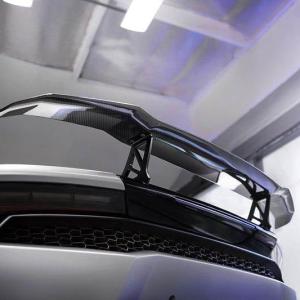
The LP610/LP580 carbon trunk spoiler is a relatively restrained way to add carbon at the rear. Before installation, place it on the deck without adhesive and inspect the contact line from left to right. The spoiler should not rock on one corner or require force to follow the panel shape.
Check the weave at the centerline. Symmetry matters because the eye naturally uses the Lamborghini badge, rear glass and deck contours as reference points. If the weave direction changes abruptly across a center seam or the clear coat distorts the pattern, it will remain noticeable after installation.
The dry-carbon Huracan rear spoiler is attractive when the rest of the car already uses dry-carbon aero, such as the dry-carbon front lip and dry-carbon rear diffuser. A consistent material family can make separate pieces look like a planned kit.
Do not choose dry carbon only because the phrase sounds more premium. On an exterior spoiler, the practical priorities are fitment, UV-stable finish, secure mounting and consistent appearance. Weight savings are welcome, but an imperfectly fitting ultralight spoiler is not an upgrade.
| Style | Best for | Main risk |
|---|---|---|
| Low-profile trunk spoiler | OEM+ road-car appearance | Can look too subtle with aggressive lower aero |
| Raised wing | Track-inspired or high-impact build | Dominates the rear if the rest of the car is stock |
| Factory-style aero theme | Owners prioritizing visual coherence | Requires careful matching of finish and proportions |
Many modified-car discussions show that enthusiasts are divided between “subtle and coordinated” and “maximum visual impact.” Instead of trying to find one universal answer, match the spoiler to the rest of the car. If the front and side profile are restrained, a low spoiler is usually coherent. If the car already has a pronounced lower package, a stronger rear element may be proportional.
If your Huracan already has factory forged-carbon components, also read the forged carbon vs woven carbon Lamborghini guide. Traditional twill and chopped/forged carbon can both be real; they simply create very different visual languages.
Small spoilers may use automotive-grade adhesive, while larger wings typically require mechanical fastening. The important point is not to improvise. Follow the mounting design of the specific component and use an installer experienced with exotic-car bodywork.
For adhesive mounting, the deck surface must be clean, decontaminated and at the correct temperature. The installer should locate the spoiler with removable reference tape before exposing adhesive. For drilled installations, alignment must be finalized before holes are made; measure relative to fixed body reference points, not just the edge of the deck lid.
The rear view works as one composition. The LP610 dry-carbon rear diffuser adds width and visual weight low on the bumper, while the spoiler adds a horizontal line higher up. Used together, they can frame the rear. Used in mismatched finishes, they can look like unrelated additions.
See the Huracan diffuser and side-skirt review for the lower package and the front lip guide for the front. The complete Lamborghini carbon fiber parts guide shows how all three areas connect.
Once the spoiler is installed, small carbon accents can repeat the material above the beltline. The Huracan LP610/LP580 2014–2019 carbon mirror covers are a natural companion because the mirrors are visible from the same side and rear angles as the spoiler. The goal is repetition, not saturation.
A dry-carbon fuel tank cap can add another subtle detail, but it is intentionally less visible. Choose these pieces after the major aero package so the small accents inherit the same gloss and weave strategy.
No. Dry carbon can be lighter and precisely laminated, but fitment, finish and mounting are decisive for an exterior spoiler.
Some low-profile spoilers are designed for adhesive installation, while others require mechanical fixation. Use the method specified for the particular product.
Inspect construction, backside laminate, edges and weave behavior. A surface pattern alone is not enough evidence.
If the car already has visible factory forged carbon, matching it creates an OEM-like result. Woven carbon can also work if the contrast is deliberate and repeated elsewhere.
Start with carbon spoilers and wings, then compare rear diffusers and front lips and splitters.
A Huracan carbon spoiler succeeds when it looks centered, sits naturally on the deck and belongs to the rest of the car's carbon package. Treat “real carbon” as the beginning of the quality check, not the end. Geometry, clear coat, edge finishing and installation are what make the difference at eye level.
Oct 03, 2026 by Lux Carbon
Oct 03, 2026 by Lux Carbon
Cookie preferences