Sep 20, 2026 / By Lux Carbon / in Carbon Fiber Guides
A carbon fiber front lip is one of the highest-impact changes you can make to a Lamborghini Huracan without replacing the entire bumper. It lowers the visual center of gravity, makes the factory nose look wider and gives the car a more complete aero profile. It is also one of the easiest carbon upgrades to damage if fitment or real-world ground clearance is ignored.
This review compares the front-end options currently available in the Lux-Carbon Lamborghini catalog, including a Huracan LP600/LP610 2014–2017 dry-carbon front bumper lip, Huracan 2014–2018 carbon fiber front bumper splitters, LP600/LP610 front bumper vents and the Huracan Performante 2017–2019 carbon front lip.
The recurring owner questions are practical rather than theoretical: Will the part sit flush at both corners? Will the center section sag? Is the carbon genuine or a fiberglass part with decorative film? Will the weave line up symmetrically? And, perhaps most importantly, will the lip survive the driveway?
Those questions should determine the buying process. A front lip can look perfect in a product image but still be wrong for a specific bumper revision or ride-height setup. The first step is always exact fitment—not the finish.
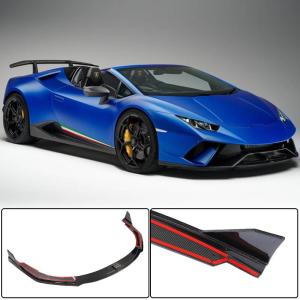
The LP600/LP610 2014–2017 dry-carbon front lip targets earlier Huracan bumper geometry. A dry-carbon construction is attractive because it can produce a crisp, lightweight shell with a clean exposed weave. The visual effect is strongest on light body colors, where the black carbon line clearly outlines the lower bumper.
Before installation, verify three things: the exact bumper type on the vehicle, whether any existing lower trim has been changed, and whether the car uses an aftermarket suspension or lift configuration. Even a correctly molded lip can become impractical if the car already has minimal clearance.
The Huracan 2014–2018 carbon front bumper splitters create a different look. Instead of adding one continuous lower element, splitters emphasize the outer corners. That can be useful for owners who want carbon without making the entire front edge look lower.
| Choice | Visual effect | Practical consideration |
|---|---|---|
| One-piece front lip | Continuous, lower and wider appearance | More exposed to ramps and curbs |
| Corner splitters | Sharper outer bumper details | Less central overhang, but corners remain vulnerable |
| Bumper vents | Subtle carbon detail higher on bumper | Fitment around factory openings must be exact |
If you are building a restrained road-car package, splitters plus the carbon front bumper vents can provide enough material contrast without committing to a full-width lip.
The Performante should not be treated as a standard Huracan with a different badge. Its aero design and factory carbon treatment are distinct, so choose a part designed for the exact bumper. The Performante 2017–2019 front bumper lip is listed specifically for that application and uses a gloss carbon appearance with a 3x3 twill specification.
On a Performante, the challenge is not merely “does it fit?” but “does it visually belong?” Compare the aftermarket weave or finish against factory forged-carbon surfaces in direct sunlight. If the new lip uses woven twill, decide whether you want the contrast or would rather keep the factory material language. The Performante carbon upgrade guide explores that problem in more detail.
A Huracan front lip can extend forward, downward or both. The danger is the change in approach angle rather than only the measured ride height. Measure the current front overhang and note which ramps, driveways or parking structures already require the nose-lift system. A part that reduces effective clearance by a small amount can change which obstacles are safe.
For frequent road use, it may be smarter to select a compact splitter profile than the most aggressive aero design. If the car is transported on a trailer, measure the loading ramp too. Carbon damage from transport is as common a practical concern as road damage.
A front lip becomes visually stronger when the carbon line continues along the body. Pair it with Huracan carbon side skirt extensions and the LP610 dry-carbon rear diffuser. If the car needs more rear emphasis, add the LP610/LP580 carbon trunk spoiler only after the lower package is balanced.
That sequencing avoids a common problem: a very large rear wing with no carbon connection at the front or sides. For a complete plan, use the rear diffuser and side-skirt review and spoiler and wing review alongside the main Lamborghini carbon fiber parts guide.
Some carbon lips can use factory fastener locations; others require additional hardware. Professional installation is recommended because the installer can clamp and support the part evenly before any permanent holes are made. Automotive tape may help locate or stabilize contact areas, but a high-speed front aero part should use the fastening method specified for the component.
After installation, inspect the lip from ground level, from both 45-degree front angles and from directly above. Small asymmetries are easier to see from a distance than while working underneath the bumper. Re-check fasteners after initial driving and after any significant contact with a ramp or road debris.
No. Model year ranges are a starting point, but bumper version and trim matter. Match the product listing to the exact car and verify the bumper before ordering.
Dry carbon can reduce weight and provide a crisp laminate, but fitment, mounting design and clear-coat durability are more important for a street-driven lip.
A full lip gives a more continuous aero look; splitters are more restrained and may preserve more clearance through the bumper center.
Do not assume so. Follow the specific product installation method. Larger aero parts commonly require mechanical fasteners or factory mounting points.
Side skirts and a rear diffuser create the most natural visual continuation. Browse carbon side skirts and rear diffusers to complete the lower aero package.
The best Huracan front lip is the one that matches the exact bumper, preserves usable ground clearance and connects visually with the rest of the build. Start with fitment, then decide between a continuous lip and corner splitters, and only then choose the carbon finish. That order produces a cleaner result than buying the most aggressive-looking component first.
Oct 03, 2026 by Lux Carbon
Oct 03, 2026 by Lux Carbon
Cookie preferences