Sep 20, 2026 / By Lux Carbon / in Carbon Fiber Guides
The Lamborghini Huracan Performante is a special case for aftermarket carbon. Unlike a base model that can be visually transformed by adding exposed carbon, the Performante already uses a strong factory composite language. The challenge is not simply adding more carbon—it is adding carbon that does not fight the factory forged-composite appearance.
This guide uses the Huracan Performante 2017–2019 carbon fiber front bumper lip as the central product and explains how to choose complementary pieces, how to deal with forged-vs-woven material contrast and how to avoid the “aftermarket patchwork” look.
Enthusiast discussions around the Performante repeatedly split on forged carbon. Some owners love the random, technical marbled pattern because it is closely associated with the model. Others prefer traditional woven carbon because the twill pattern looks more familiar and visually ordered. Both preferences are legitimate; what matters for an upgrade is whether the combination looks intentional.
If a new component uses traditional twill, place it where the material transition is visually understandable. A front lip can work because it forms a separate lower plane. A small replacement inserted directly beside factory forged carbon demands closer matching.
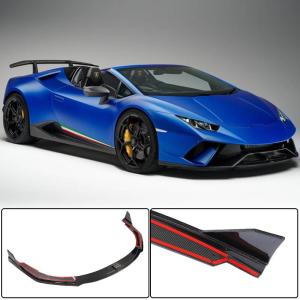
The Performante carbon front lip is listed for 2017–2019 applications and described with a gloss 3x3 twill carbon specification. That immediately tells a Performante owner something important: this is visually different from random-pattern forged composite.
That difference can be used intentionally. The front lip sits at the lowest edge of the bumper and can act as a contrasting woven-carbon frame. Before committing, compare the part against the car in daylight and from five to ten meters away. Close-up texture is only part of the result; overall proportion matters more.
| Material appearance | Character | Best use on a Performante |
|---|---|---|
| Forged / chopped composite | Random, marbled, highly distinctive | When matching factory-style surfaces is the priority |
| Woven twill carbon | Directional, technical, visually ordered | As a deliberate contrast on separate aero planes |
| Mixed package | Can look bespoke or inconsistent | Works only when the contrast repeats deliberately |
The forged carbon vs woven carbon Lamborghini guide goes deeper into construction terminology and the practical visual checks owners ask about.
A Performante front lip should connect to the rest of the lower silhouette. Compare carbon side skirts and rear diffusers and splitters before adding unrelated upper-body accents. The goal is to make the carbon line read continuously around the car.
For standard Huracan examples that illustrate the same principle, see the Huracan diffuser and side-skirt review. The exact Performante rear components may differ, but the design logic—front, side, rear, then upper details—remains useful.
The Performante already has a specific aerodynamic identity, so any aftermarket rear aero should be approached carefully. Generic Huracan spoilers such as the LP610/LP580 carbon trunk spoiler are useful references for material and finish, but should not be treated as automatic Performante fitment.
If you are comparing spoiler quality rather than exact fitment, the Huracan carbon spoiler review explains the core checks: deck contact, symmetry, weave, edge finish and secure mounting. For a Performante, add one more requirement—preserve the factory aero logic and verify compatibility with the specific rear bodywork.
Carbon vents can add texture without dramatically changing the silhouette. The Huracan LP600/LP610 front bumper vents illustrate how small carbon parts can be used, but again they must be matched to the exact bumper application. Do not order based solely on the visual similarity between Huracan variants.
For the Performante, small detail parts are most convincing when their finish either matches a nearby factory component or clearly belongs to the same aftermarket package as the front lip.
Because the front lip is exposed, consider paint-protection film over compatible clear-coated carbon after installation. The film installer should confirm adhesion to the carbon clear coat and avoid trapping contamination at sharp edges. A ceramic coating can add easier cleaning but does not replace impact protection.
Use the vehicle's lift system where available, but do not assume it prevents all contact. The added lip changes the approach angle. Measure the new lowest point and practice familiar ramps slowly after installation.
Not necessarily. It will contrast with factory forged-carbon surfaces, but that contrast can look deliberate when the woven part occupies a distinct aero plane.
Do not assume so. Use a product designed and listed for the Performante bumper.
Material performance depends on resin system, fiber orientation, laminate design and manufacturing process. Appearance alone does not determine structural strength.
Prioritize exact fitment, consistent gloss, controlled panel gaps and repeated material treatment. Avoid mixing too many unrelated patterns.
Start with the Performante front lip and compare the wider Lamborghini carbon catalog before planning additional components.
The Performante rewards restraint. One well-fitted carbon component that respects the factory design can look more expensive than five mismatched pieces. Decide first whether you want to match the forged-carbon identity or deliberately contrast it with woven carbon, then keep that decision consistent across the build.
Oct 03, 2026 by Lux Carbon
Oct 03, 2026 by Lux Carbon
Cookie preferences