Sep 20, 2026 / By Lux Carbon / in Carbon Fiber Guides
Carbon mirror covers are one of the most popular “small part, big visibility” modifications on the Lamborghini Urus. The mirrors sit high on the vehicle, catch direct light and are visible from the front, side and driver's seat. That also means poor fitment or mismatched gloss is hard to hide.
This review focuses on the Lamborghini Urus / Audi Q8 2018–2021 dry-carbon mirror covers and the questions owners commonly ask: add-on or replacement, real carbon, gloss vs matte, weave matching and whether a small carbon part can still look OEM.
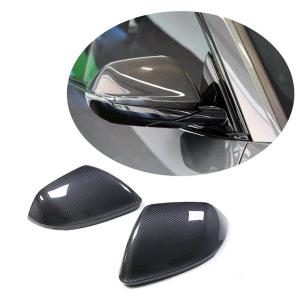
A mirror cover has compound curves and a sharp outer edge. Carbon cloth has to follow those curves without obvious distortion, and the finished shell must sit evenly around the original housing. A poor mold can create thick-looking edges or gaps near the indicator and mirror glass.
Because the left and right mirrors are symmetrical references, compare them together. The carbon pattern should feel intentionally mirrored or consistently oriented. Randomly different weave directions can make otherwise good pieces look cheaper.
An add-on cap installs over the factory housing, while a replacement component substitutes the original outer shell. The product design determines the method; never assume one from the photograph alone.
| Type | Advantages | Watch for |
|---|---|---|
| Add-on cover | Less disassembly, reversible in many cases | Edge thickness, adhesive coverage, added bulk |
| Replacement shell | Potentially more factory-like thickness | More disassembly, clips/tabs must fit precisely |
If a cover uses adhesive, surface preparation is critical. Wax, ceramic coating or silicone residue can reduce bond strength. If it is a replacement shell, every clip and tab should engage without forcing the carbon.
Owner discussions often debate matte versus gloss mirror carbon. Gloss makes the weave look deeper and generally integrates easily with gloss-black exterior trim. Matte or satin carbon is more technical and understated, but it can look mismatched if every other carbon part is high gloss.
Choose the finish by looking at the entire vehicle, not the mirror alone. If the Urus already has glossy dry-carbon front splitters and rear splitters, matching gloss usually creates the cleanest connection. If the car has satin factory trim, a softer finish may work better.
Do not expect zero weave distortion on a complex three-dimensional surface. The goal is controlled, visually balanced drape rather than mathematically perfect straight lines everywhere.
A convincing carbon pattern on the surface does not alone prove construction. Inspect the backside, edges and any openings. Real carbon fibers have depth and structural continuity that printed hydrographic patterns do not. Carbon-skinned composite is also different from a full-carbon shell; both can be legitimate products, but they should be described accurately.
For a broader explanation of chopped/forged and woven constructions, see the forged carbon vs woven carbon Lamborghini guide.
Mirrors are ideal as the second or third step in a build. Start with lower aero such as front splitters and rear splitters, then repeat the material at eye level with mirror covers. The dry-carbon side vents can connect the mirror to the front fender visually.
If you want a stronger side profile, add dry-carbon wheel-arch trims. The complete sequencing is covered in the Urus carbon fiber parts upgrade guide and the main Lamborghini carbon guide.
For replacement shells, use trim tools appropriate for the vehicle and avoid levering directly against carbon edges. If the mirror has cameras or sensors, calibration and function should be checked after reassembly.
Mirror caps collect insects and road film at the leading edge. Clean them gently because aggressive polishing on a narrow curved surface can thin the clear coat quickly. If a chip appears, repair the clear coat before moisture reaches exposed laminate edges.
The featured product is listed for 2018–2021. Verify the exact mirror housing and year before ordering later models.
Not automatically. A thin, accurately molded add-on can look excellent; a poor replacement shell can fit badly. Judge the actual component.
For a coordinated build, matching gloss and weave family is recommended.
Simple adhesive covers can be DIY-friendly, but cameras, indicators, clips or replacement housings increase the risk. Professional fitting is safer on a high-value vehicle.
Browse the carbon fiber mirror covers category and the Lamborghini catalog.
Urus mirror covers are a good test of carbon quality because you see them constantly and at close range. Prioritize mold accuracy, thin edges, balanced weave and a finish that matches the rest of the vehicle. If those details are correct, a small part can look more OEM than a much larger body-kit component.
Oct 03, 2026 by Lux Carbon
Oct 03, 2026 by Lux Carbon
Cookie preferences