Sep 20, 2026 / By Lux Carbon / in Carbon Fiber Guides
The Lamborghini Urus offers more surface area for carbon upgrades than a Huracan, but that does not mean more carbon automatically looks better. On the SUV's larger body, the most convincing modifications are packages that repeat the same material at the front, sides and rear rather than isolated carbon pieces.
This guide reviews the main Urus products available through the Lux-Carbon Lamborghini catalog: dry-carbon front and rear splitters, wheel-arch trims, fender vents, mirror covers and engine-bay covers. It also explains how to keep a daily-driven Urus practical.
| Area | Product | Best reason to choose it |
|---|---|---|
| Front | Dry-carbon front bumper splitters | Defines lower bumper without replacing it |
| Rear | Dry-carbon rear bumper splitters | Balances front carbon visually |
| Wheel arches | Dry-carbon wheel eyebrow arch trims | Adds carbon around large SUV wheel openings |
| Side detail | Dry-carbon side air fender vents | OEM+ accent higher on the body |
| Mirrors | Dry-carbon mirror covers | Visible from front and side; small but effective |
| Engine bay | Dry-carbon engine-bay covers | Showpiece detail without changing exterior |
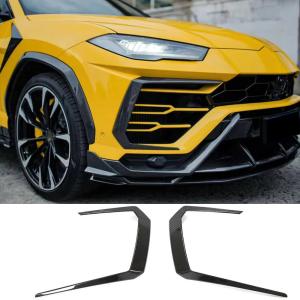
The Urus 2018–2022 front bumper splitters are a sensible starting point because they introduce carbon at the lowest front corners without requiring a full bumper replacement. The large Urus grille and bumper already have complex geometry, so corner accents can be enough to sharpen the front.
Check parking-curb exposure and approach angle. The Urus has more ground clearance than a Huracan, but the front overhang is still vulnerable, especially if the splitter projects outward.
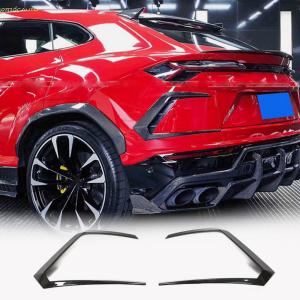
The matching dry-carbon rear bumper splitters prevent the car from looking “carbon-heavy” only at the front. Their job is partly aesthetic: they repeat the same material on the opposite end of the vehicle.
Inspect exhaust and lower bumper clearances carefully. The rear bumper sees heat, water, road salt and grime, so edge sealing and clear-coat quality matter as much as visible weave.
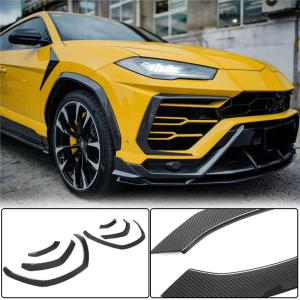
The Urus wheel eyebrow arch trims are visually significant because the arches occupy so much of the side profile. Unlike a small badge-sized accent, arch carbon can change the perceived width and stance of the SUV.
That visibility demands excellent left/right consistency. Compare the weave orientation on all four corners and check the gap to painted arch surfaces. Any unevenness is easier to spot because the wheel provides a perfect circular reference.
The 2018–2022 dry-carbon side air fender vents and Urus/Audi Q8 dry-carbon mirror covers move the carbon theme above the lower bumper line. This is where moderation matters. On a dark vehicle, both can look subtle; on a bright green, yellow or white Urus, they become strong graphic accents.
For a deep comparison of add-on versus replacement mirror designs, gloss consistency and fitment, see the Urus dry-carbon mirror cover review.
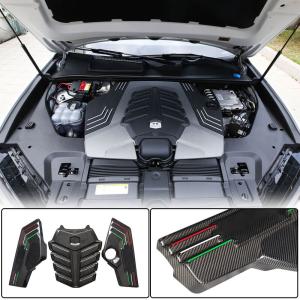
The Urus 2018–2022 dry-carbon engine-bay covers are an appealing choice for owners who want craftsmanship rather than a more aggressive exterior. Engine-bay pieces are seen at shows, service visits or when the bonnet is opened, yet they do not change parking clearance or body silhouette.
Heat exposure matters. Ensure the component is designed for the engine-bay environment and that it does not interfere with insulation, service points or cooling airflow.
The Urus dry-carbon racing front seatback cover set brings the material into the interior. Interior carbon is viewed at closer range than exterior aero, so surface finish, edges and fit around seat mechanisms become especially important.
Any seat-related trim must preserve movement, seat controls, airbags and safety functions. Professional installation is appropriate when components sit near seat-mounted safety systems.
Subtle OEM+: mirrors + side vents. Balanced exterior: front splitters + rear splitters + mirrors. Full visual package: front and rear splitters + wheel arches + vents + mirrors. Show/detail package: exterior set + engine-bay covers and seatbacks.
Use the main Lamborghini carbon fiber guide to compare this strategy with Huracan and Aventador builds. If material terminology is your main concern, read forged carbon vs woven carbon for Lamborghini before mixing textures.
Some products are listed for both platforms, but compatibility should be verified against the exact mirror housing and model year rather than assumed.
Professional dry-fitting is recommended because four large curved pieces must align consistently around the wheel openings.
Yes, provided the clear coat and edges are durable and lower parts are installed securely. Regular inspection is important because an SUV sees more varied road conditions.
Mirror covers or side vents are low-commitment visual additions. Front and rear splitters create a more complete exterior transformation.
Compare carbon mirror covers, front splitters, exterior panels and vents and canards.
The Urus benefits from coordinated carbon more than isolated accessories. Build from the front and rear lower pieces, repeat the material on mirrors or vents, and add wheel-arch carbon only when you want a stronger visual transformation. That keeps the SUV premium rather than visually busy.
Oct 03, 2026 by Lux Carbon
Oct 03, 2026 by Lux Carbon
Cookie preferences