Sep 15, 2026 / By Lux Carbon / in Carbon Fiber Guides
Carbon fiber mirror covers are one of the simplest ways to add a visible carbon fiber detail to a performance car without replacing a bumper, hood, diffuser or complete body panel. Their position at eye level makes them surprisingly noticeable, while their relatively small size means they can work equally well as a first carbon upgrade or as the finishing detail on a vehicle that already has a carbon fiber front lip, rear spoiler, diffuser or side skirts.
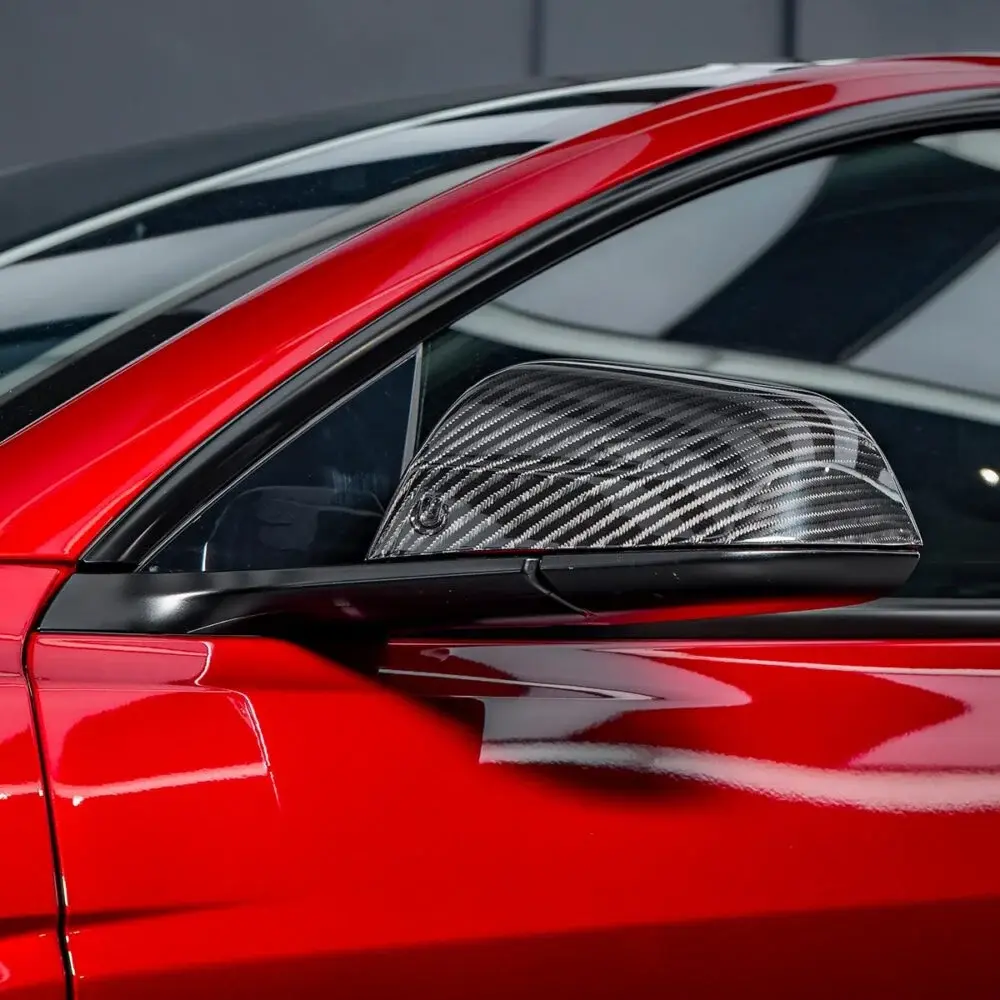
The difficult part is not deciding whether carbon mirrors look good. The difficult part is choosing the correct type for the exact vehicle. Mirror housings can change between generations, facelifts, trim levels and regional specifications. Some vehicles also incorporate turn signals, cameras, lane-change sensors, courtesy lights or other equipment into the mirror assembly.
This guide explains the differences between replacement mirror caps and add-on covers, dry and wet carbon fiber, gloss and matte finishes, common weave patterns, fitment issues, installation methods and the details that should be checked before ordering.
If you are already looking for a vehicle-specific set, browse the carbon fiber mirror covers available on Lux Carbon and compare the listed generation, installation type and configuration with your original mirrors.
Mirror caps occupy a useful position in exterior design. They sit away from the main body panels, so a contrasting carbon surface is easy to notice without dominating the entire appearance of the vehicle.
This makes carbon fiber mirror covers particularly effective on cars finished in white, grey, silver, red and bright blue, where the dark carbon weave produces a strong visual contrast. On black vehicles the effect is more subtle, but the weave becomes visible under direct light and can match other carbon components around the car.
Mirror covers also work well because manufacturers already use contrasting mirrors on many factory performance models. BMW M cars, Mercedes-AMG models, Audi RS vehicles and other performance-oriented cars frequently use black, carbon-look or genuine carbon exterior accents. Replacing painted or plain plastic mirror caps with genuine carbon therefore tends to look consistent with the overall design language of a performance vehicle.
Unlike large aero components, mirror caps normally require no major body modification. Depending on the design, installation may involve either attaching a shell over the original cap or replacing the factory outer housing completely.
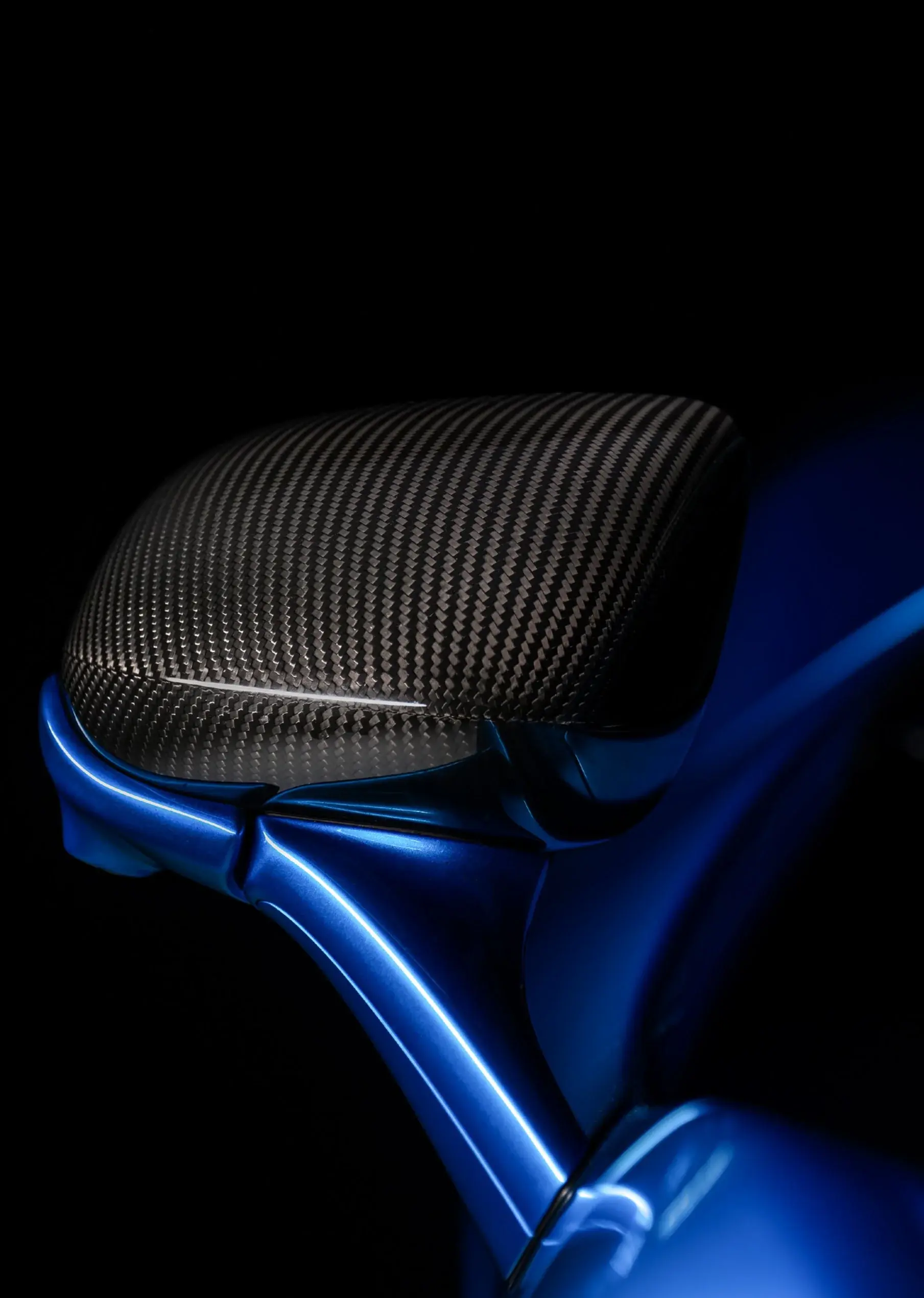
The most important distinction when buying carbon fiber mirror covers is whether the product is an add-on cover or a replacement cap. They may appear almost identical in photographs, but installation and final appearance are different.
Add-on covers are manufactured to sit over the existing factory mirror housing. The original cap remains installed underneath.
Typical advantages include:
A well-designed add-on piece follows the shape of the original mirror closely. However, because it sits on top of the factory shell, it inevitably adds a small amount of thickness around the edges.
This is usually difficult to notice from normal viewing distance, but owners seeking the most factory-like result may prefer a complete replacement cap.
Replacement mirror caps remove the original outer housing and install in its place. They generally use mounting tabs and attachment points corresponding to the original component.
The main advantages are:
The trade-off is installation complexity. Removing a factory mirror cap sometimes requires carefully releasing several plastic clips. Depending on the vehicle, the mirror glass or internal trim may also need to be moved before the outer cap can be removed safely.
Before buying, always check whether the product description states add-on, overlay, replacement or another installation configuration.
Not every carbon fiber exterior component is manufactured using the same process. Two of the most common descriptions are dry carbon fiber and wet carbon fiber.
Dry carbon components are typically made using pre-impregnated carbon fabric where the resin content is controlled before curing. Depending on the production process, the component may be cured under heat and pressure.
For a small component such as a mirror cap, dry carbon can offer:
Dry carbon is particularly suitable for replacement-style mirror caps because a thin structure can reproduce the dimensions of the original shell without unnecessarily increasing bulk.
Wet carbon typically refers to carbon fabric that receives resin during the manufacturing process rather than using pre-impregnated material.
Properly manufactured wet carbon can still produce an excellent exterior component. For cosmetic parts such as mirror covers, appearance, mould quality, resin distribution and clear-coat quality are often more important to the owner than a small difference in weight.
The crucial distinction is between genuine carbon fiber and products made from ABS or fiberglass with a printed carbon pattern. A carbon-look plastic component can reproduce the general visual pattern from a distance, but it is not the same material as a real woven carbon laminate.
Product photographs should show an actual woven structure beneath the clear finish. Genuine carbon fabric has depth because individual fiber bundles reflect light differently as the viewing angle changes.
A printed pattern usually looks flatter and more uniform. Repeating graphics may also become visible when inspected closely.
That does not automatically make carbon-look ABS a bad product. ABS covers can be inexpensive, durable and suitable for owners interested primarily in styling. The important issue is simply knowing what material you are buying.
When a product is described as carbon fiber, dry carbon or forged carbon, it should be evaluated separately from products clearly labelled carbon-look ABS or carbon pattern.
Carbon fiber is available in several visual patterns. Matching the weave is particularly important if the vehicle already has carbon parts installed.
Twill is one of the most recognizable automotive carbon patterns. Fiber bundles form diagonal lines across the surface, creating the familiar performance-car carbon appearance.
It is widely used for:
For owners gradually building a complete carbon exterior, twill is generally the easiest pattern to match across different components.
Plain weave has a tighter checkerboard-like pattern. It can look slightly more technical and less directional than twill.
Neither twill nor plain weave is inherently better for a cosmetic mirror cover. The choice is primarily aesthetic.
Forged carbon uses chopped carbon fibers rather than a conventional woven sheet. The result is an irregular, marble-like appearance where no two pieces look exactly the same.
Forged carbon is visually much stronger than traditional woven carbon. It works particularly well on modern performance cars with other forged-carbon accents, but mixing a forged mirror housing with conventional twill aero parts may produce an inconsistent appearance.
For that reason, decide whether the vehicle will follow a traditional woven-carbon theme or a forged-carbon theme before adding several exterior pieces.
Most exterior mirror covers use either a gloss or matte clear finish.
Gloss is the most common choice because the clear coat creates depth and makes the carbon weave more visible. It also coordinates naturally with gloss-black trim commonly fitted around windows, grilles and exterior mouldings.
Gloss carbon works especially well when the vehicle already uses gloss carbon on a front lip or splitter, rear diffuser or spoiler.
Matte carbon has a quieter, more technical appearance. Reflections are reduced, so the weave can appear softer and less dramatic.
Matte works particularly well on vehicles with satin paint, matte wraps or other non-gloss carbon components.
Mixing gloss and matte finishes is possible, but it should normally be intentional. Two adjacent carbon parts with different clear-coat finishes can otherwise look mismatched even when the carbon weave itself is identical.
Mirror covers are highly vehicle-specific components. Two cars from the same manufacturer may use similar-looking mirrors while having completely different mounting points or outer geometry.
Before ordering, verify:
A product title covering several models does not necessarily mean every version of those models uses identical mirrors. The compatibility information in the product description should always take priority over assumptions based on appearance.
Car manufacturers frequently redesign mirror housings during a generation change. A BMW G-series mirror, for example, may look conceptually similar to an earlier F-series mirror but use a different shell shape and attachment system.
The same applies to Volkswagen Golf generations, Mercedes-Benz chassis families, Audi model generations and many other vehicles.
Even a facelift within the same generation can introduce changes.
This is why searches such as “BMW carbon mirror covers” are too broad for making a purchase. A useful product match needs to identify the actual chassis or production range whenever possible.
For example, the Lux Carbon mirror category currently includes vehicle-specific options covering platforms such as Volkswagen Golf MK6, MK7/MK7.5 and MK8, Toyota GR86, Toyota GR Supra A90, Tesla Model Y and many other applications. These are separate fitment groups and should not be treated as interchangeable simply because they are sold under the same product category.
Modern mirror assemblies are no longer simple plastic housings around a mirror glass.
Depending on the vehicle specification, the mirror may include:
The outer carbon cap must not obstruct any opening required by this equipment.
A replacement mirror housing designed for a vehicle without a camera may physically resemble the version used on a camera-equipped vehicle but still lack the necessary opening. The same problem can occur with turn signal or courtesy-light configurations.
Whenever a product offers separate variants such as “with camera hole” and “without camera hole,” treat that distinction as a required fitment specification rather than an optional styling choice.
Many mirror caps are physically identical between left-hand-drive and right-hand-drive vehicles. However, this should not be assumed for every product.
Some mirror designs, internal mounting structures or accessory openings can vary between markets. If a product explicitly states LHD or RHD, choose the specification matching the vehicle.
This is particularly important when ordering parts internationally, where the seller's domestic vehicle configuration may differ from the buyer's market.
A quality mirror cover should follow the factory housing with consistent panel gaps and clean edges.
For an add-on cover, check:
For a replacement cap, check:
Never force a replacement cap into position when the clips clearly do not align. Excessive pressure can damage both the carbon component and the factory mirror assembly.
Add-on covers are usually the easiest type to install, but surface preparation determines whether they remain secure.
A typical installation process involves:
Do not use the adhesive to compensate for incorrect fitment. If a cover needs to be heavily bent or forced against the housing, verify the product application before permanently attaching it.
Replacement-style caps require more care because the original housing must be removed.
The exact procedure varies by vehicle. On some cars the factory cap can be released from the exterior using trim tools. On others, access to retaining clips may require partial removal of the mirror glass or internal trim.
Plastic factory clips can become brittle with age and temperature exposure, so removal should be performed carefully.
If the procedure for the specific vehicle is unclear, professional installation is normally preferable to experimenting with the mirror assembly. Replacing damaged power-folding mechanisms, cameras or heated mirror glass can cost far more than professional installation of the carbon caps.
A properly designed replacement cap should normally rely primarily on its mechanical mounting points. Adhesive may be used in some applications as additional security, but it should not be necessary to hold a badly fitting replacement shell in position.
If a replacement cap cannot stay seated without large amounts of adhesive, recheck the model, year and configuration.
Mirror covers are most effective when they form part of a coordinated exterior design rather than being treated as an isolated accessory.
A common progression is:
The goal is not necessarily to install every available carbon component. A balanced car often looks better with carbon details positioned around the vehicle rather than covering every body panel.
Mirror covers are especially useful for visually connecting front and rear carbon components. Because the mirrors sit approximately halfway along the vehicle, they create another carbon reference point between a front splitter and rear spoiler or diffuser.
If you are building a larger exterior package, you can compare other vehicle-specific parts in the Lux Carbon carbon fiber body kits, side skirts and rocker panels and related exterior categories.
Owners building premium carbon packages often focus on material type but overlook weave direction.
Twill carbon has a visible diagonal direction. On a symmetrical pair of mirror covers, some manufacturers mirror the weave direction between left and right sides, while others use the same directional sheet orientation on both components.
Neither approach affects normal use, but enthusiasts seeking perfect visual symmetry may prefer mirrored weave orientation.
The same issue becomes more noticeable when several carbon components sit close together. Matching weave scale, direction and gloss level helps separate a cohesive carbon package from a collection of unrelated aftermarket pieces.
Exterior carbon fiber constantly faces sunlight, temperature variation, rain, road contamination and repeated washing.
The outer clear layer is therefore extremely important. It provides the visible gloss or matte finish while helping protect the resin beneath it.
Poor-quality exterior carbon can eventually develop:
A good exterior finish with UV resistance helps reduce these problems.
Mirror caps receive considerable sunlight because they project away from the body and are rarely shaded. Proper maintenance is therefore worthwhile even though the parts themselves are relatively small.
Maintenance is similar to other clear-coated exterior surfaces.
Use normal automotive shampoo and a clean microfiber wash mitt. Avoid aggressive household detergents or abrasive cleaners.
For gloss carbon:
For matte carbon, avoid products that create artificial gloss. Use cleaning and protection products intended for satin or matte surfaces.
Automatic brush car washes can introduce fine scratches into gloss clear coat, just as they do on painted bodywork. Hand washing is preferable when maintaining a high-gloss carbon finish.
Yes. A clear-coated carbon mirror cap can generally be treated similarly to clear-coated automotive paint, provided the coating product is suitable for the surface finish.
A ceramic coating can make cleaning easier and reduce how strongly water and contamination adhere to the surface. It does not make the carbon immune to stone chips or physical damage, but it can simplify routine maintenance.
For matte carbon, use a coating specifically intended to preserve a matte appearance.
Replacement dry-carbon caps can be lighter than equivalent factory components, but weight reduction should not be the primary reason to buy mirror covers.
The total weight involved is very small compared with large panels such as a carbon hood, roof or trunk lid.
Add-on carbon covers may actually increase total mirror weight slightly because the original cap remains underneath.
For mirror components, the main benefits are appearance, material quality and integration with the rest of the carbon exterior. Weight saving is secondary.
| Feature | Real Carbon Fiber | Carbon-Look ABS |
|---|---|---|
| Material | Carbon fiber composite | Plastic with carbon-style finish or pattern |
| Appearance | Real woven depth and light reflection | Printed or molded carbon appearance |
| Weight | Very low, especially dry carbon | Generally lightweight |
| Cost | Higher | Lower |
| Best for | Premium builds and genuine carbon packages | Budget-focused cosmetic upgrades |
Both materials can serve a purpose, but the product description should make the distinction clear. Buyers wanting genuine carbon should not choose only by appearance in small thumbnail photographs.
A model can span several generations and facelifts. Always check production years and chassis generation.
The installation method significantly changes both fitment and final appearance.
Modern mirror equipment must remain unobstructed.
Twill, plain and forged carbon can all look excellent, but combining them unintentionally can make the exterior appear inconsistent.
Check whether the actual material is carbon fiber, dry carbon, forged carbon, fiberglass or carbon-look ABS.
Always place the part on the vehicle and inspect alignment before removing adhesive backing or completing permanent installation.
Mirror covers work on almost any vehicle with a compatible part, but they are especially effective on cars that already have a performance-oriented design.
Popular applications include vehicles from:
The right choice depends less on the manufacturer and more on whether a properly moulded component exists for the exact mirror design.
BMW is one of the most common applications for carbon mirror caps because carbon exterior details naturally complement M Sport and M-car styling.
However, BMW fitment requires attention to chassis codes. Similar-looking models may use different mirror assemblies, and true M cars sometimes use mirror housings that differ from standard or M Sport models.
Check the exact chassis generation and never assume an M-style appearance means the mirror shell is interchangeable between models.
Mercedes-Benz and Mercedes-AMG models use numerous mirror configurations across C-Class, E-Class, CLA, CLS, GLC, GLE, AMG GT and other platforms.
Production year and chassis family should therefore be verified carefully.
Carbon mirror caps work particularly well with AMG-style exterior packages because they can visually connect dark grille trim, front splitters, side skirts, rear spoilers and diffusers.
Audi and Volkswagen models are another strong application because many enthusiasts already use gloss-black or aluminum-style factory mirror caps as styling accents.
Carbon can provide a more performance-focused alternative.
Golf GTI and Golf R generations are particularly sensitive to model-year fitment. MK6, MK7/MK7.5 and MK8 mirror parts should be treated as separate applications unless explicitly stated otherwise.
The same principle applies to Audi generations and body styles.
The current Toyota performance lineup has become an important part of the carbon aftermarket.
The GR Supra A90/A91 and GR86 are frequently modified with carbon mirror covers, spoilers, front lips, side skirts and diffusers.
The Supra also shares components and architecture with some BMW applications, which is why certain aftermarket mirror products may list both Toyota and BMW models. That does not mean all BMW mirror caps fit the Supra; only use combinations explicitly listed by the manufacturer or seller.
Pricing varies according to manufacturing method, material, vehicle complexity and whether the product is an add-on or complete replacement shell.
A small ABS overlay with a carbon pattern should naturally cost less than a genuine dry-carbon replacement housing.
The cheapest product is not automatically the best value if poor moulding creates uneven gaps or requires excessive adhesive. At the same time, a high price alone does not guarantee correct fitment.
For this type of component, fitment accuracy and correct vehicle specification should be considered before cosmetic details such as weave preference.
Add-on mirror caps can often be installed at home with careful preparation.
Professional installation becomes more sensible when:
A mirror is a relatively small exterior component, but modern mirror assemblies can contain expensive electronics. Saving a small installation charge is not worthwhile if incorrect removal damages those systems.
Once mirror covers are installed, the next step should not automatically be “add more carbon.” Instead, look at the vehicle as a complete design.
A strong carbon package usually establishes visual balance between the front, side and rear of the car.
For example:
Using the same weave and finish across these components helps create the impression of a planned package rather than a collection of unrelated modifications.
Before ordering, confirm the following:
Checking these details before ordering is far more important than choosing solely from product photographs.
Carbon fiber mirror covers offer a relatively simple way to change the exterior character of a vehicle while introducing genuine carbon into areas that remain highly visible from almost every angle.
The best result comes from choosing a part designed specifically for the vehicle rather than treating mirror caps as universal accessories. Generation, production year, installation type, camera configuration, weave and finish all matter.
For a factory-style result, replacement carbon caps provide the cleanest integration. For an easier and reversible installation, add-on covers can be an excellent alternative. Dry carbon offers particularly thin and lightweight construction, while traditional carbon laminates can still provide the woven appearance enthusiasts expect from a premium exterior upgrade.
Browse the complete Lux Carbon mirror cover collection and filter by vehicle, material, configuration and finish to find options designed for the correct application.
For owners building a broader exterior package, matching mirror caps with a carbon fiber front lip, carbon side skirts, rear diffuser or carbon spoiler can create a much more coherent result than selecting each component independently.
Oct 03, 2026 by Lux Carbon
Oct 03, 2026 by Lux Carbon
Cookie preferences